An engineer reaches the gate of a project in north Riyadh and is asked for proof of safety training before he can go in. He does not have any. That evening he goes looking for the route in: where to begin, which certificate counts, how long it takes. The short answer is that this career now has a clearer entry point than it has ever had, because the regulatory framework in the Kingdom sets out the professional categories and their requirements in writing. The long answer is this article.
What a safety specialist actually does all day
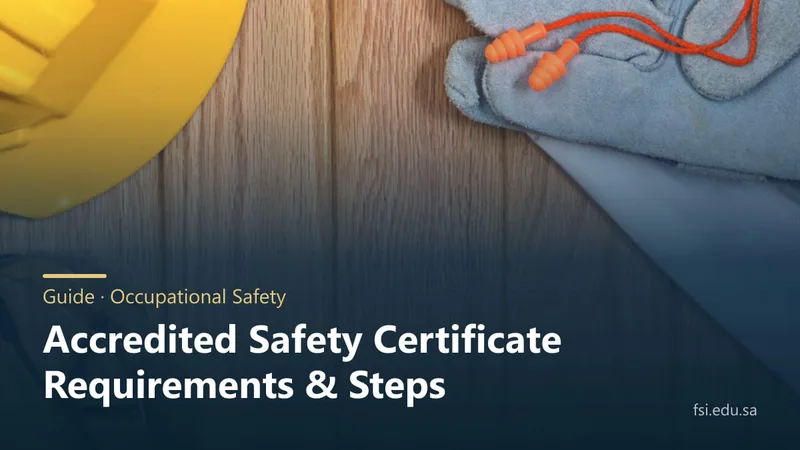
The stock image — a man in a hard hat standing on a site — hides more than it shows. At its core the work is a loop that repeats: observe, assess, intervene, document.
Observation begins with the site walk. The specialist moves through the site, the plant, the kitchen or the warehouse, comparing what is there against what should be there: clear emergency exits, serviceable and inspected extinguishers, no exposed wiring, personal protective equipment actually worn rather than stored in a locker. Then comes the written risk assessment — naming the hazard, identifying who is exposed, judging likelihood and severity, then setting the controls and who owns each one. This is the central skill of the profession, and it is analytical and written work before it is fieldwork. It is also the first surprise for anyone who came to the field expecting site work alone.
Hazardous tasks carry their own permits: work at height, hot work, confined space entry, energy isolation. Each has a procedure, a document and a signature, and work does not start until they are complete. A short pre-task briefing precedes execution, while periodic awareness training and hazard induction for new employees run in the background.
When an incident or a near miss happens, the investigation opens: what happened, why it happened, and what stops it happening again. Near misses are the more valuable of the two, in our view, because they are a warning that cost nothing.
Compliance runs through the whole year. One close example is the ban on outdoor work under the sun in private-sector establishments from 15 June to 15 September, between 12:00 and 15:00. Scheduling around it, monitoring it and evidencing it all land on the specialist. At month end everything gathers into a report: indicators, an open-and-closed findings log, and corrective plans that each carry an owner and a deadline.
So a large share of this job is writing and follow-up. Anyone who dislikes documentation will not last long here.
The sectors that need this role
The Occupational Safety and Health Management Regulation came into force in the Kingdom on 1 July 2018. It places written requirements on establishments with fifty or more full-time workers, and applies a higher tier — the medium level — to the higher-risk activities: construction, petroleum and gas, electricity and water, health services, mines and quarries, cement, petrochemicals and manufacturing. Other activities at the same headcount fall under the minimum level.
Picture an HR manager at a restaurant chain that grew this year until its payroll passed fifty. The business had not changed. The obligation had. That is how demand widens: hotels, restaurants, hospitals, schools, warehouses and shopping centres all carry that same obligation once they reach that headcount, and each then needs someone to own the file.
Then came the Regulation on the Organization of Work in High-Risk Occupations — approved by ministerial decision number (64762) of 13/5/1447 AH, published in the Official Gazette in January 2026 and in force since July 2026, one hundred and eighty days after publication — which widens the circle further. It applies across the public, private and non-profit sectors, classifies occupations as hazardous or restricted, and requires the worker to hold a licence after completing an approved training programme and occupational fitness examinations. Every establishment where such work takes place needs someone to track the licences, the examinations and the training, and to document them.
The path from beginner to specialist
One: the knowledge base
What separates a hazard from a risk? What is the hierarchy of controls, and why does substitution come before personal protective equipment? Where do the employer's duties end and the worker's begin? Answer those three with confidence and you have hold of the logic of the profession; the vocabulary follows on its own. A short introductory programme is enough at this stage, and its real purpose is to tell you whether the field suits you before you invest time and money in it. The introductory occupational safety and health programme was designed for exactly that.
Two: accredited foundation training
This is where you move from knowing about the work to being able to do it: writing a full risk assessment yourself, understanding incident sequence and root causes, working with permits and inspection records. The stage needs an accredited programme with enough hours behind it and a certificate an employer can read and verify, which is what the accredited foundation programme in occupational safety and health delivers across 18 hours over three days, under approved training plan 94015.
Three: specialising in specific hazards
General safety alone does not carry you on a real site. Fire fighting has its own logic and equipment; construction safety has its own requirements around scaffolding, excavations and work at height. Someone who covers all three can take responsibility for a whole site instead of depending on others for half the file, which is why the occupational safety bundle brings the three tracks together in 60 hours.
Four: licensing and professional progression
The Regulation for Licensing and Accrediting Occupational Safety and Health Practitioners and Service Providers was approved by decision number (64764) of the Minister of Human Resources and Social Development, published in the Official Gazette in January 2026 and, one hundred and eighty days on from publication, in force since July 2026. Its article eleven states that no occupational safety and health profession may be practised, and no such service provided, without the licence or accreditation issued by the Council.
The regulation lays out the career ladder across two tracks. The practitioner track runs from technician to expert technician to specialist, and covers the operational and executive work carried out under supervision. The professional track takes in senior specialist, trainer, expert, senior expert, consultant and senior consultant, and covers supervision, consultancy and policy building.
Article twenty-eight ties each category to academic qualification, ranked upward from a secondary school certificate combined with professional credentials or approved training programmes, through associate diploma, bachelor's, master's and doctorate, and to professional experience in direct proportion to that qualification. Registration with the relevant professional body is added where applicable: the Saudi Council of Engineers for engineering roles, and the Saudi Commission for Health Specialties for occupational health practitioners.
So is a university degree required? A secondary certificate plus approved training is a recognised entry point into the practitioner track. Climbing the ladder, though, calls for a higher qualification and documented experience, and our advice is to plan for that early, before it ambushes you years later.
The skills that make the difference
Precise writing comes first. A vague incident report is worthless, and a risk assessment without measurable controls ends up in the archive. Communication and persuasion follow, because the specialist usually holds no direct executive authority; persuading the supervisor, the worker and the management is the first tool available. If that is a weak point, effective communication skills is an investment at the centre of the profession.
Then there is what a classroom teaches only with difficulty: systematic observation, seeing what everyone else has learned to walk past, and asking "what if?" before the incident asks it for you.
Add a working knowledge of the framework — where to find the text matters more than memorising it, since regulations change and tracking the change is part of the job. Composure under pressure belongs here too: the moment of an incident is a moment for action, and blame waits until the file is closed. Technical English closes the list: most references, standards and major-contractor reporting are written in it.
The certifications the path is built on
- A locally accredited training certificate: the practical starting point, because it sits under an approved training plan that an employer can read and verify.
- The NEBOSH International General Certificate: the awarding body sets no prior qualification for entry, the qualification consists of two units, and a minimum of 63 taught hours plus roughly 40 hours of private study is recommended. Assessment is a scenario-based open-book digital examination together with a practical risk assessment carried out in a real workplace.
- OSHA outreach cards (10 and 30 hours): the US Occupational Safety and Health Administration states plainly that none of the courses in the Outreach Training Program is considered a certification, and that the programme is voluntary and does not meet the training requirements of its own standards. They are useful evidence of knowledge, not a licence to practise.
- ISO 45001:2018: the international standard setting out the requirements for an occupational safety and health management system. Knowing it moves you from carrying out instructions to building the system the instructions come from.
We would not advise collecting certificates for their own sake. No certificate promises a job. It opens the door to the interview; what keeps you in the room is your portfolio — assessments you wrote, incidents you investigated, indicators that improved on your watch.
Where to start in practice
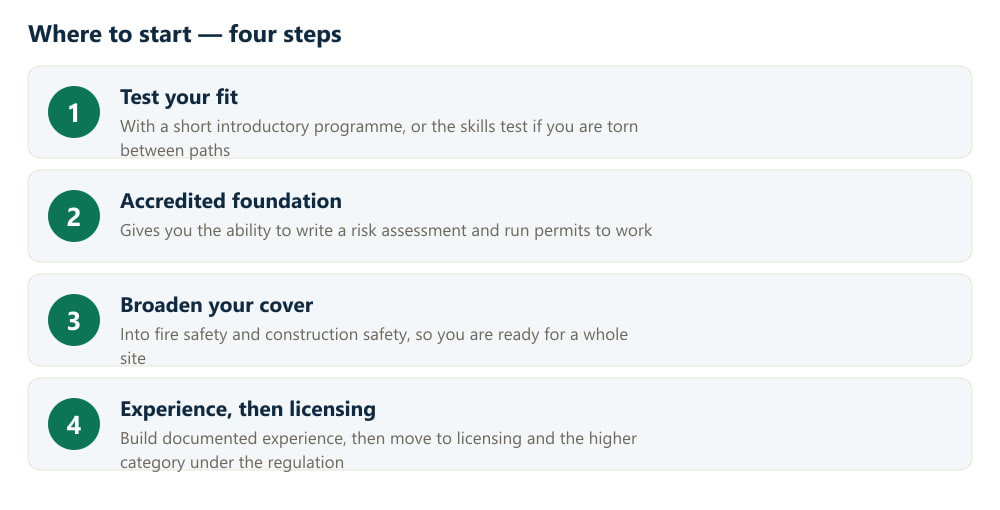
- Test your appetite for the field with a short introductory programme, or with the skills assessment test if you are weighing more than one direction.
- Take accredited foundation training that leaves you able to write a risk assessment and run a permit system, through the accredited foundation programme in occupational safety and health.
- Widen your coverage into fire fighting and construction safety through the occupational safety bundle, so you are qualified for a whole site.
- Build documented experience, then move on to licensing and to the higher category along the path the regulation sets out.
And the engineer at the gate? Step two is what he needs, with step one a week ahead of it.
Training at Future Skills Training Co — licensed by the Technical and Vocational Training Corporation — is delivered in person in Riyadh or remotely by live broadcast, with prices inclusive of VAT and instalments available through Tabby and Tamara. Organisations looking to qualify a whole team can read about corporate training, browse the frequently asked questions, or reach us through the contact page.