

A regular morning at a car dealership in Jeddah. A customer has been waiting an hour for his car, and nobody has told him when it will be ready. The technician finished long ago, the front desk is busy on the phone, and the invoice has a line item nobody explained. No single person made a mistake, yet the whole experience went wrong. That is exactly what customer experience programmes try to fix: making every touchpoint work like one team.
What happened?
Mohamed Yousuf Naghi Motors, Ford's authorised distributor in the Western and Southern regions of Saudi Arabia, announced it has earned the Ford Guest Experience certification. The final assessment took place on 8 and 9 September 2026, according to Sabq newspaper. The company said its frontline teams spent 3 months aligning sales and service processes with Ford's global standards.
The news concerns one company, but the signal is broader. Saudi businesses no longer stop at the slogan of putting the customer first. They are now measured against it, audited by outside parties, and asked for action plans with deadlines and targets.
Certifying a business is not certifying a person
Two kinds of certification are often confused:
- Organisational certification: a brand or quality body awards it to a dealership or branch after auditing its operations. It looks at processes and behaviour on the floor, not at any one employee.
- Professional certification: an individual earns it by passing an exam, and it travels with them from job to job. The best known in this field is the CCXP, awarded by the Customer Experience Professionals Association (CXPA).
The first says the place works well. The second says the person knows how to design, measure and improve an experience. A business chasing the first usually needs people with the knowledge behind the second.

What does the CCXP measure?
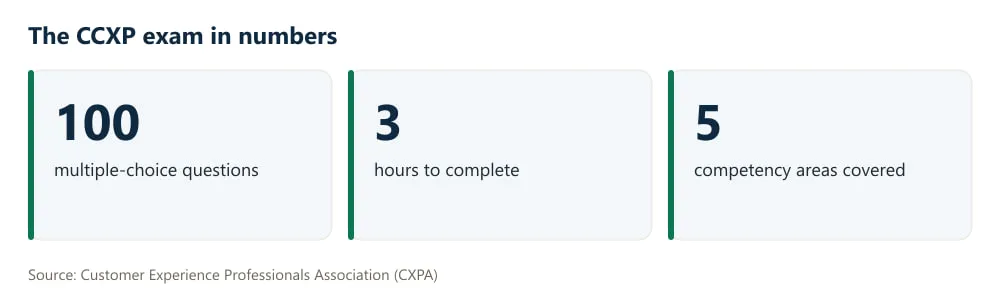
According to the association's official site, the CCXP exam has 100 multiple-choice questions and lasts 3 hours. It covers 5 competency areas:
- Customer insights and understanding.
- Customer experience strategy.
- Culture and accountability.
- Design, implementation and innovation.
- Metrics, measurement and ROI.
Eligibility requires experience: a post-secondary degree with 3 years of full-time customer experience work, or an alternative route for high-school graduates that requires 5 years of experience. In other words, it is built for practitioners, not complete beginners. Check CXPA's current requirements before you apply; it is the only authoritative source.
Who should care?
- Customer service staff and supervisors who want to move from solving complaints to preventing them.
- Branch and dealership managers facing an audit from a brand or quality body.
- Marketing and product teams that collect customer feedback but are unsure what to do with it.
- Small businesses losing customers quietly without knowing why.
Practical steps to start this week
- Map one customer journey: from first contact to after the sale. List every touchpoint and who owns it.
- Find the biggest pain point: five short calls with real customers reveal more than a long report.
- Pick one metric: post-service satisfaction, response time, or repeat rate. Do not start with ten.
- Give every step an owner: experiences fall apart when they are everyone's job.
- Review after a month: compare the new number with the old one and decide what to keep and what to change.
Common mistakes
- Reducing the experience to the front desk: customers judge the whole journey, from the website to the invoice.
- Collecting surveys without acting: asking customers and ignoring their answers is worse than not asking.
- Waiting for the audit to start: certification is the result of daily work, not a project rushed the week before a visit.
- Confusing satisfaction with loyalty: a satisfied customer may still not come back, and you need to know why.
How we can help
Future Skills Institute's CCXP Customer Experience Certification Preparation programme runs for 25 hours online and walks through all five competency areas with examples from Saudi workplaces. Trainees receive a certificate of completion from the institute; the CCXP itself is awarded by CXPA after passing its exam and meeting its requirements. The institute is licensed by the Technical and Vocational Training Corporation. See the course page for details.