

An online shop owner in Riyadh opens her message inbox one morning. A customer had written, in everyday Saudi Arabic, asking when their order would arrive. The AI assistant answered in stiff, formal classical Arabic that sounds nothing like the way she talks to her customers. The answer was correct, but cold. In another thread the assistant read a local expression literally and missed the point entirely. Any business using AI for customer service will recognise this scene.
What the studies found
The second session of the Fifth International Annual Conference of the King Salman Global Academy for Arabic Language discussed research on how well language models understand Arabic in its cultural context. The studies recommended expanding Arabic text collections to cover the Saudi dialect and other Arabic dialects, fine-tuning models on dialect data, and pairing human expertise with AI tools.
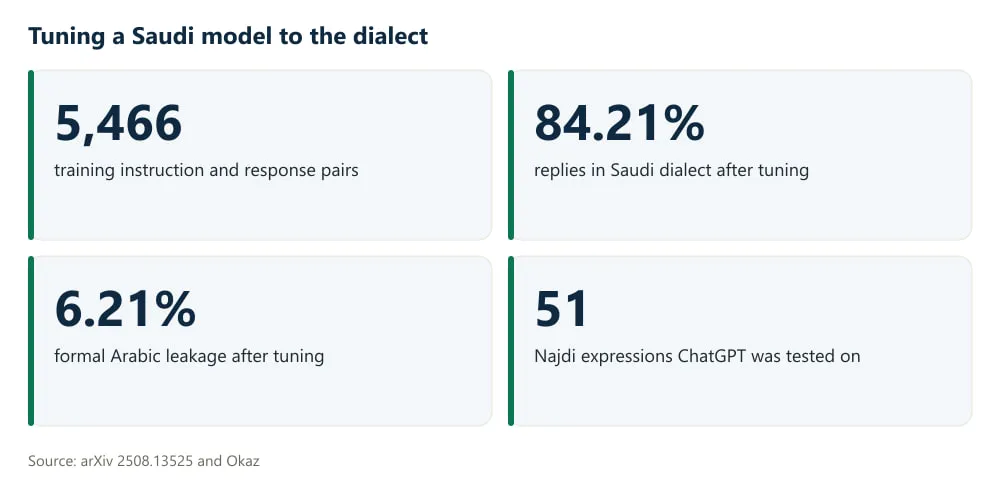
One study tested how ChatGPT handled 51 religious expressions common in the Najdi dialect, and found uneven performance where meaning depends on cultural context. Another found that differences between models are sharpest with proverbs and idioms. The practical takeaway reported by the newspaper: model outputs need linguistic review before they are used.
Can the model itself get better?
Yes, and the numbers show how. In a 2025 paper, researchers fine-tuned the Saudi model ALLaM-7B on 5,466 instruction-and-response pairs in Hijazi and Najdi Arabic. The share of replies written in Saudi dialect rose from 47.97% to 84.21%, while leakage of formal Arabic into replies fell from 32.63% to 6.21%.
For a business owner the lesson is simple. A general model will not speak your customers' dialect on its own. Clear instructions and well-chosen examples, however, bring it much closer, long before any technical training.
Who should care
Anyone writing to Saudi customers with machine help: online stores, restaurants and cafés handling orders, clinics and service offices, and marketing teams drafting social posts. Customers judge a business by the tone of its reply before its content, and one misread local phrase can turn a simple question into a complaint.

Practical steps for this week
- Collect twenty real customer messages written in their own dialect, and remove any personal data.
- For each one, write the reply you would be happy to send, in your brand's voice.
- Add a short tone description and a few of these replies as examples in the assistant's instructions.
- Test the assistant on fresh messages that include proverbs and local expressions, and note where it slips.
- Make human review mandatory for anything involving money, complaints or commitments.
- Review a sample of replies every week and update the examples with what you learn.
Common mistakes
- Putting the assistant in front of customers without testing it on real messages.
- Assuming a grammatically perfect formal reply suits every situation.
- Translating a local expression word for word instead of grasping what it means.
- Pasting customers' personal data into public tools without checking their privacy terms.
- Dropping reviews because most replies looked fine in the first week.
Where training helps
The AI Fundamentals for Entrepreneurs programme covers, over twenty hours, how to choose the right tool for your business, how to write clear instructions for it, and how to review its output before it reaches a customer. It runs online, and participants who complete it receive a certificate of completion from the institute, which is licensed by the Technical and Vocational Training Corporation. Details are on the programme page.