

On a Sunday morning, the marketing lead of an online store in Riyadh opens three ad dashboards: one for Instagram, one for Snapchat and one for TikTok. Each platform reports a successful campaign. Then the manager asks a simple question: which riyal actually brought in sales? There is no single answer. The bigger the ad budget, the more often this happens, and in Saudi Arabia that budget is growing fast.
What do the new figures say?
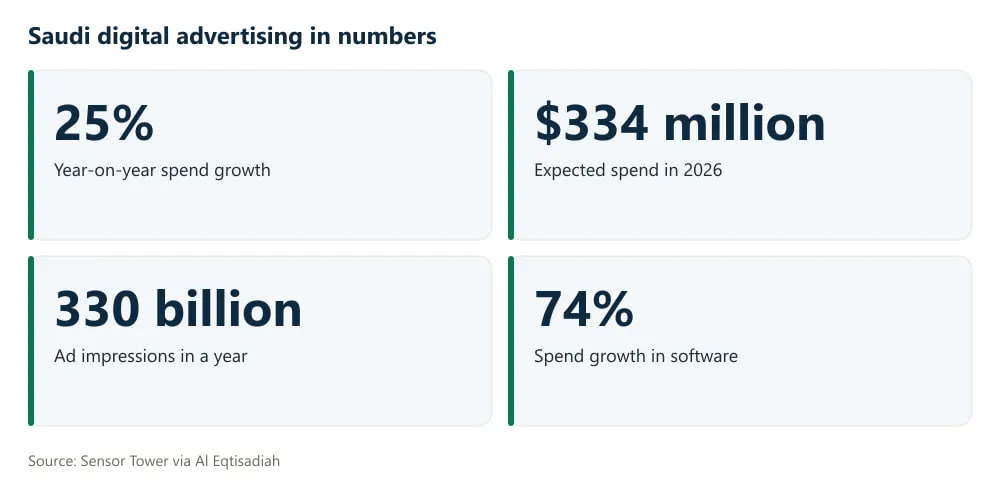
Al Eqtisadiah newspaper, citing Sensor Tower's State of Digital Advertising report, says digital ad spend in the Kingdom reached about $300 million in the twelve months to July 2026, up 25% year on year. The report expects full-year 2026 spend to reach $334 million. Ad impressions rose to 330 billion impressions, growth of 15%.
Sectors are not moving at the same pace. According to the same report, software advertisers increased spend by 74% and food and restaurants by 42%, while online shopping remained the largest category by volume. New sectors are entering the ad market in force, and anyone working in them will soon be asked to justify every riyal spent, not just report view counts.
Why this matters if you work in marketing or management
When spend grows faster than impressions, each impression costs more on average. In that situation, platform reports alone are not enough, because every platform measures success its own way and credits the sale to itself.
The teams that win are the ones that bring ad data and sales data into one place and compare channels with one yardstick. That is a data analysis skill first. It matters most for:
- Digital marketers running budgets across several platforms.
- Small business owners and e-commerce founders paying for ads out of their own pocket.
- Finance analysts asked to judge the return on marketing spend.

Practical steps to read your ad spend
- Bring the sources into one table: export platform reports by day, campaign, cost, impressions and clicks, and link them to sales data from your store or accounting system.
- Agree on definitions: decide with your team what counts as a conversion and as a new customer before calculating any ratio.
- Build a shared date table: week-on-week and month-on-month comparisons only hold if every table reads the same calendar.
- Track a few clear measures: customer acquisition cost, return on ad spend, and cost per thousand impressions.
- Show them in one auto-refreshing dashboard: so the manager sees exactly what the team sees, without scattered spreadsheets.
Common mistakes
- Adding up platform results as reported: if every platform claims the same sale, total sales will look bigger than they are.
- Stopping at clicks: a cheap click does not mean a cheap customer.
- Monthly manual reports: copy and paste introduces errors that are hard to spot.
How to build this skill
Microsoft Power BI is one of the most widely used tools for this kind of work: it pulls data in, cleans it, models the relationships between tables and publishes dashboards that refresh automatically. Microsoft's PL-300 exam measures four areas: preparing the data, modelling it, and visualising and analysing it, each weighted 25–30%, plus managing and securing Power BI at 15–20%. The passing score is 700.
Future Skills Institute, licensed by the Technical and Vocational Training Corporation (TVTC), offers Data Analysis with Power BI: PL-300 Preparation online over 30 training hours. Participants practise these areas with hands-on business examples and receive a certificate of completion from the institute. The Microsoft certification itself is earned by passing Microsoft's exam.