
Nine in the morning in a Riyadh office tower. The alarm sounds for an unannounced evacuation drill. Some employees freeze, unsure which staircase to take. Others go back for their laptops. One heads straight for the lift. There is no fire, but the first few minutes reveal what paperwork cannot: the emergency plan exists in a binder, not in people's heads.
That gap is what new partnerships in the safety sector aim to close. Saudi Arabia's National Council for Occupational Safety and Health (NCOSH) has announced a memorandum of understanding with King Abdullah Financial District (KAFD), one of Riyadh's largest office clusters.
What the MoU covers
According to NCOSH, the agreement rests on five areas: exchanging expertise and best practice in occupational safety and health, supporting awareness initiatives that build a prevention culture, developing capacity through training programmes, workshops and specialist meetings, exploring technology and smart applications, and sharing lessons learned to improve risk management.
The bigger message is that workplace safety is no longer only about factories and construction sites. An office tower is a full workplace, with thousands of employees, restaurants, car parks, lifts and electrical and cooling systems. A failure there affects many people at once.
What the official numbers say
In April 2026 the General Authority for Statistics (GASTAT) published its Health and Safety at Workplace statistics for 2025. Several figures matter to any employer:
- The non-fatal occupational injury rate was 245 per 100,000 workers, and the fatal rate 1.3 per 100,000, excluding road accidents.
- The risk awareness index among workers reached 76.7%.
- Only 51.8% of workers reported preventive measures being available at work.
- 25.3% stand for four hours or more a day, and 16.7% report fatigue or overwork.
- 6% reported work-related stress in the past twelve months.
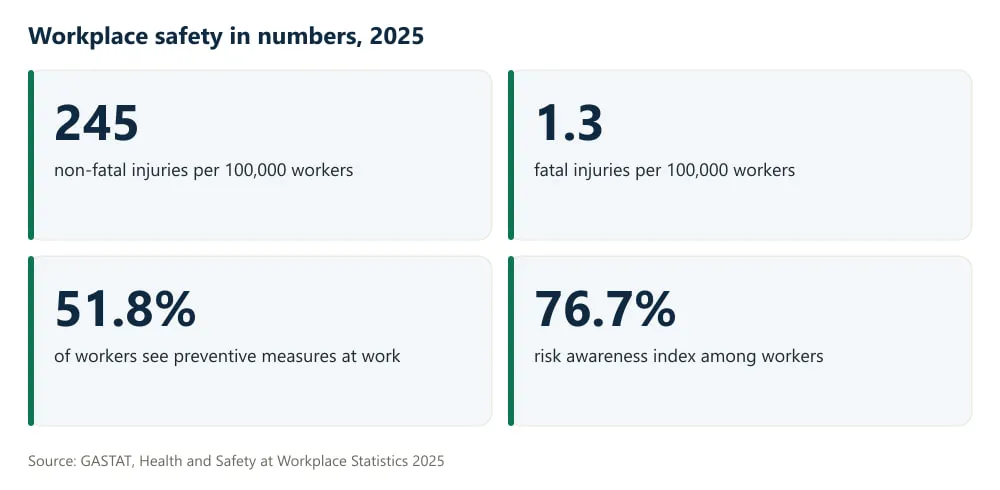
The gap between awareness and practice is clear. Most workers understand the risks, yet only about half see real preventive measures around them. That gap is closed by training and daily routines, not by posters.
Office risks people overlook
Office hazards differ from factory hazards, but they are real:
- Emergencies and evacuation: exits blocked by boxes, fire doors propped open, staff who have never joined a drill.
- Electrical: daisy-chained extension leads under desks, damaged chargers, equipment left on overnight.
- Slips and trips: wet floors near pantries, cables across walkways.
- Physical ergonomics: long sitting, screens at the wrong height, eye and back strain.
- Psychological pressure: long hours and back-to-back deadlines, reflected in the fatigue figure above.

Practical steps for employers
- Name a clear owner: one person per floor or department who knows the emergency plan and leads evacuation.
- Actually run drills: regular drills that time the evacuation and expose blocked exits and bad habits.
- Inspect with a fixed checklist: exits, extinguishers, electrics and floors, every month, the same way.
- Log near misses: the slip that hurt nobody today may hurt someone tomorrow.
- Train everyone, not just the safety lead: safety is collective behaviour, and short, repeated sessions beat one annual lecture.
- Mind the ergonomics: adjustable chairs, screens at eye level, short movement breaks.
Common mistakes
- Relying on a written emergency plan nobody has read.
- Treating safety as the building manager's job alone, when tenants have duties to their own staff.
- Leaving new joiners out of awareness and training.
- Treating stress as a personal matter unrelated to how work is organised.
For specific cases or detailed regulatory questions, contact NCOSH and the Ministry of Human Resources and Social Development directly.
How training helps
If your organisation wants to build a solid knowledge base among staff, the Occupational Safety Bundle at Future Skills Institute combines three specialist programmes in one enrolment, delivered online, with a certificate of completion. The institute is licensed by the Technical and Vocational Training Corporation. The bundle builds knowledge and preventive behaviour; licensing of safety practitioners is issued by NCOSH under its own requirements. Details are on the bundle page.