"Free course with an accredited certificate." The phrase turns up so often in training advertising that it has nearly stopped meaning anything, and some of what sits behind it is serious while some of it is not.
The difference never shows in the advertisement. It shows in three things anyone can check before signing up: who is paying for the training, who licensed the body delivering it, and what document you will actually hold at the end.
This guide works through all three, then sets out the conditions of the free programmes we run, in full — including the employment condition many people miss — so you know whether you qualify before you fill in a single form.
Who funds free training in Saudi Arabia?
No training is free of cost.
A programme is free to the trainee because somebody else absorbed the cost, and in the Kingdom that cover usually comes through one of two routes.
The first is a funding route. The Human Resources Development Fund, known as Hadaf, was established to support the qualification and employment of the national workforce in the private sector, and one of its initiatives is Doroob, an e-learning platform: registration carries no fees at all, programme costs are paid by the Fund, and the trainee receives a completion certificate once the programme requirements are met. Any Saudi citizen may register. Alongside it sits Taqat, the national labour portal, an online platform that brings jobseekers and employers together and offers employment and training services in one place, including Tamheer, which places Saudi graduates in real workplaces, and the job search subsidy for registered jobseekers.
A third pattern belongs to that same route, known as training that ends in employment: an employer posts a vacancy, the Fund covers the candidate's training, and the trainee is hired by the employer and registered with social insurance from the start of the training. The Fund's strategic partnership institutes programme works this way, and it requires the applicant to be a Saudi national and a registered jobseeker who is not employed anywhere.
The second route is strategic. The Human Capability Development Programme, one of the Vision 2030 realisation programmes, was launched in September 2021 and rests on three pillars: building a solid and flexible educational foundation for all, preparing for the future labour market, and enabling lifelong learning. A great many of the free training initiatives announced today grow out of that wider framework.
What the two routes share is that the funding is national in character. That is exactly why the Saudi nationality condition keeps reappearing in eligibility rules: it is not exclusion for its own sake, it is the condition set by whoever is paying.
How do you know a free offer is serious?
Four questions are enough, and every one of them can be checked before you register.
Start with the provider: is it licensed? Private training in the Kingdom is licensed by the Technical and Vocational Training Corporation, and the licence represents the Corporation's approval to invest in training. The Corporation itself directs trainees to an online lookup service where you can confirm that a private training establishment and its courses are properly registered. Search for the provider's name there. If you cannot find it, stop at that point.
Then look at the programme: is it accredited, or is it just content? The executive rules of the private training regulation state that the Corporation may approve training programmes, return them for amendment, or reject them; they oblige the establishment to prepare its courses and training materials in line with approved programmes; and they prohibit issuing certificates that breach training regulations and instructions. In practice that means an accredited programme carries a plan number, and the number is something you can ask to see written down in front of you. On our own site it is published on the programme page itself: plan 94015 for foundational occupational health and safety, and plan 98859 for effective communication skills. We are licensed by the Corporation, and some of our programmes carry a published plan number while others do not carry one yet. We would rather say so than let you assume otherwise.
The third question is about the document. An attendance certificate is one thing; a completion certificate for an accredited programme is another. Ask who issues it, and whether it can be verified afterwards by a code. We make that possible through our certificate verification page, and in our view any serious provider should offer something equivalent.
The fourth is the simplest and the most often skipped. Are the fees genuinely zero? Some free offers conceal a registration fee, a certificate issuance fee, or an examination fee at the end. Ask plainly whether any amount is payable at any stage. A serious answer is yes or no. A detour is an answer of its own.
The conditions of our three free programmes
We deliver three fully free programmes under a national initiative, all of them in hospitality: coffee preparation and service, food and beverage service, and culinary arts. The conditions are published, short, and not open to interpretation.
Admission is restricted to Saudi men and women, because the programmes are funded under a national initiative aimed at citizens.
Nationality is not the only condition, and this is where most of the confusion sits. The initiative targets two specific groups: employees who started their current job in April 2026 or later, and job seekers, on condition of being hired by the sponsoring employer. If neither applies to you, your application will not be accepted however well you meet the first condition — even if you are Saudi and working in the same sector, Saudi and in the right sector though they may be — and saying so here is more useful than letting them discover it after filling in the form.
Your national ID number is requested at registration and verified on the server before a seat is confirmed. The condition is not a self declaration you tick and move past.
The practical details are short. Twenty training hours spread across two weeks, a schedule built to stay manageable alongside study or a job, delivered in person at our Riyadh premises or remotely by live broadcast. And no fees whatsoever: no registration fee, no certificate fee, no payment of any kind at any stage of the programme.
What does twenty hours actually give you?
Start with what a short programme does not do: it will not turn you into a finished professional in two weeks, and it guarantees neither a job nor a salary.
What it does give you is a structured, practical grounding in a skill the market asks for, a document proving you completed it, and a starting point for applying to entry level opportunities in hospitality. Anyone who wants to go deeper afterwards will find longer and more specialised programmes in the catalogue.
That same point doubles as a test of how serious any offer is. A provider promising a guaranteed job or a specific salary in exchange for twenty hours of training is overselling, and we would not advise registering there; an inflated promise tells you more than the price tag does, and it is more dangerous. An inflated promise tells you more than the price tag does.
And the rest of our programmes are open to everyone
The nationality condition is sometimes misread as a blanket company policy. It is not. It applies to the free programmes alone, because it is the funder's condition. The paid programme catalogue is open to everyone with no nationality restriction, citizens and residents alike, including PMP project management, business English with artificial intelligence, and sales and customer retention skills. Prices include VAT, and instalments are available through Tabby and Tamara.
How to apply to the free programmes
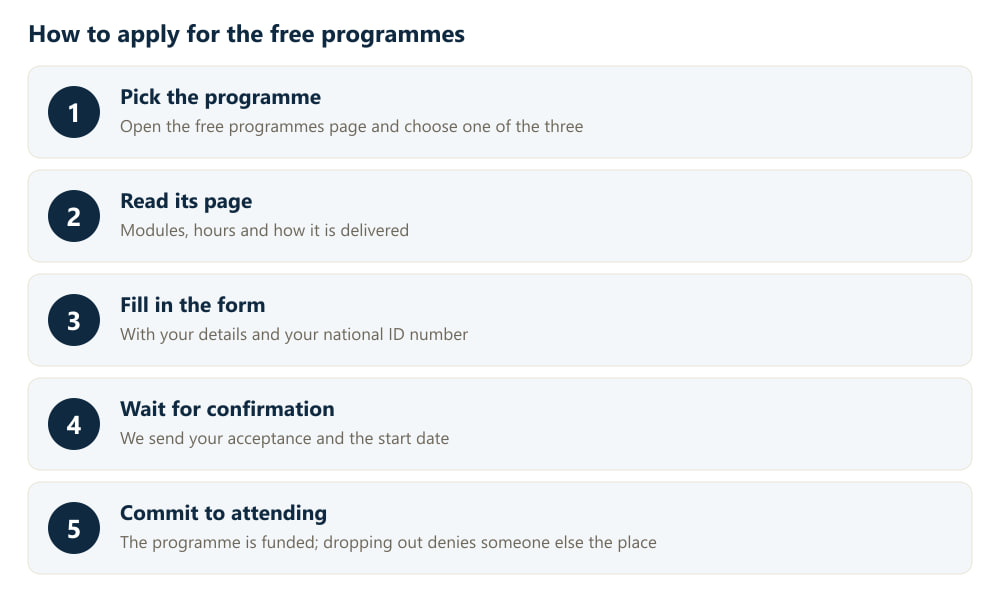
- Open the free programmes page and choose whichever of the three suits you.
- Read the programme page itself: the modules, the hours, the delivery method.
- Complete the registration form with your details and your national ID number.
- Wait for us to confirm your place and the start date.
- Commit to attending: the programme is funded, and dropping out takes the place away from someone else.
If the conditions do not apply to you, the road is not closed. We would start with the skills assessment test, which suggests a path from the programmes open to everyone. And if you are asking as the corporate training page is for organisations that want to train their teams — an HR manager weighing a whole team against part of it will find the answer there, the corporate training page is the better place for you to begin. Further answers sit in the frequently asked questions.
Start here
If you are a Saudi citizen who started a job in April 2026 or later, or a job seeker with an employer ready to hire you after training, the three programmes are available to you at no cost: twenty hours across two weeks, in person in Riyadh or remotely by live broadcast. Review the free programmes page, or reach us through the contact page or on WhatsApp at +966 53 987 4076 with a specific question about eligibility or the start date of the next programme.