It is nine in the morning at a company in Riyadh, and a customer service agent picks up a call from a customer whose order is a week late. She can defend the company and explain the process, or she can listen first, sum up what the customer said, and offer a clear fix with a time attached. The second option takes no special talent. It is a skill you can learn and practise, and it is what people are really looking for when they search for an effective communication course: how to say what you mean clearly, understand what the other person needs, and reach an outcome together.
What effective communication means at work
Effective communication is not about eloquence or talking more. It means your message lands the way you intended, and you check that it did. It rests on four pillars: a clear, concise message; active listening that catches meaning, not just words; tone and body language that match what you say; and feedback that closes the loop and prevents misunderstanding.
At work, the skill stretches to email, meetings, short presentations, conversations with customers, and handling disagreement with a colleague or manager without turning it into a feud.
Why employers want it now
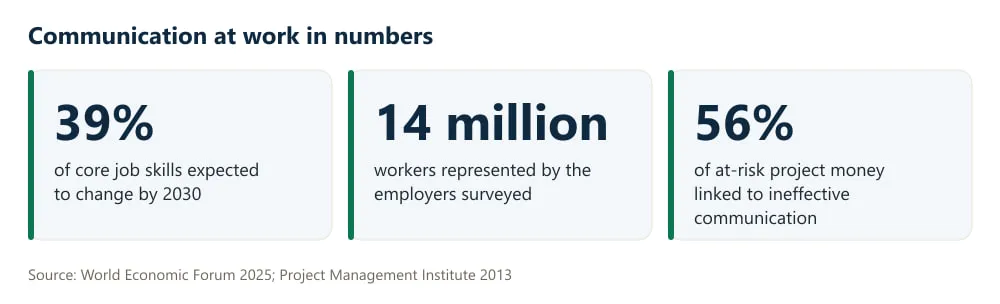
The World Economic Forum's Future of Jobs Report 2025 draws on more than 1,000 employers representing around 14 million workers across 55 economies. They expect 39% of the core skills needed in jobs to change by 2030. Analytical thinking tops the list, but leadership and social influence, empathy and active listening, and service orientation all feature among the skills employers treat as core.
The cost shows up clearly in projects. In its 2013 Pulse of the Profession report, the Project Management Institute (PMI) found that for every US$1 billion spent on projects, about US$135 million is at risk, and 56% of that at-risk amount is linked to ineffective communication.
What you learn in an effective communication course
Programmes vary in detail, but a serious course usually covers:
- The elements of the communication process, and why messages get distorted between sender and receiver.
- Active listening: paraphrasing, open questions, and holding back judgement.
- Non-verbal communication: tone, body language and eye contact, including in remote meetings.
- Professional writing: an email that can be read in thirty seconds and ends with a clear ask.
- Handling difficult conversations and conflict, and giving and receiving feedback.
- Communicating with customers: defusing anger, explaining the fix, and following through.

Communicating with customers: steps to try tomorrow
- Listen to the end. Do not interrupt, even if you recognise the problem from the first sentence.
- Sum up what you heard. A line like "So the order is late and you need it before Thursday" tells the customer you understood.
- Acknowledge the impact, not just the mistake. The delay disrupted their plans, so say so.
- Offer a specific fix with a time. "I will check with the warehouse and call you before 2 pm" beats "we will try".
- Close the loop. Call back on time even if the fix is not complete, and say where things stand.
Common workplace communication mistakes
- Long messages with no ask. Put the request in the first line and the detail after it.
- Assuming understanding. "Clear?" is not enough; ask the other person to sum up what you agreed.
- Taking disagreements to the group. Hard feedback is given in private; thanks are given in front of the team.
- Using text for sensitive moments. Some conversations need a call or a meeting, not a message.
- Tuning out in remote meetings. Turning the camera off and scrolling email while someone speaks sends a message of its own.
How to choose an effective communication course
Ask three questions before you sign up. Does the programme include practical exercises and role-plays, not just lectures? Is its training plan approved by an official body, or does it award a certificate of completion? And is it long enough for real practice? The skill is built through repetition and feedback, not in a single hour.
The Effective Communication Skills programme
Future Skills Institute, licensed by the Technical and Vocational Training Corporation (TVTC), runs its Effective Communication Skills programme online over 25 training hours. Its training plan is approved by TVTC. The programme gives you the tools and room to practise; the impact on your work comes from applying them day to day afterwards. You will find the modules and dates on the programme page.