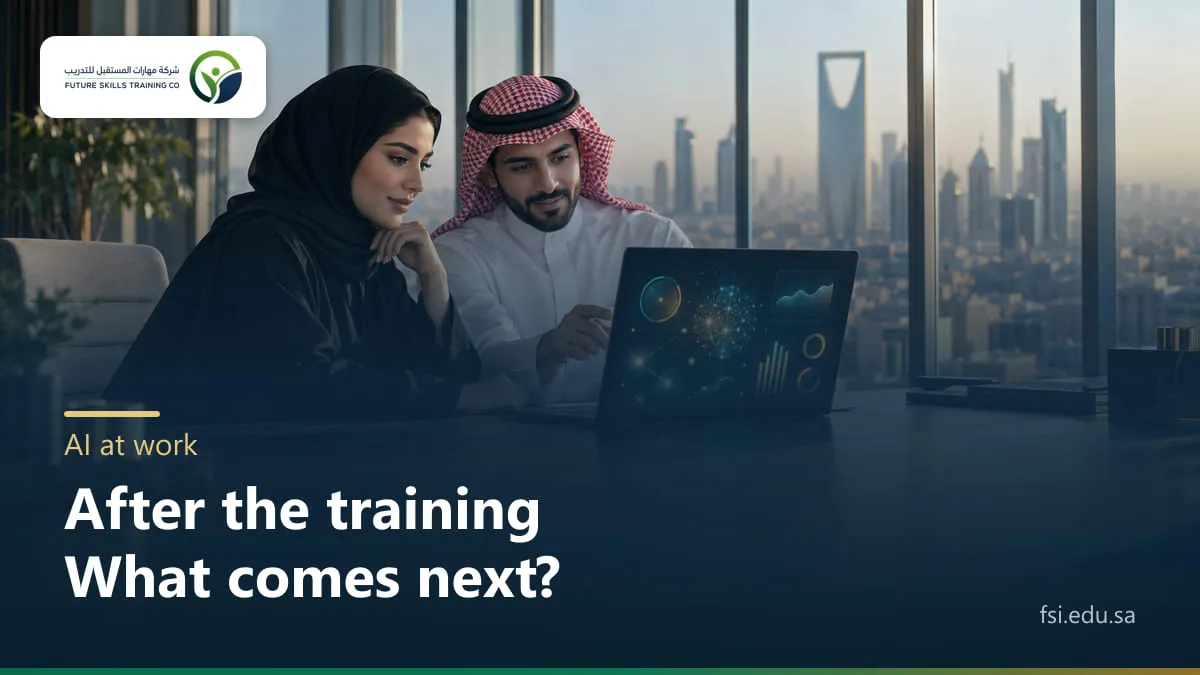
At a morning meeting in a Riyadh company, a manager asks an employee to summarise a thirty-page proposal from an overseas supplier and draft an English reply before noon. She finished an introductory AI course a few months ago. She knows what a language model is and what a prompt does. The harder question is practical: how does she use the tool for this exact task without leaking company data, and without sending a reply that reads awkwardly? That question now applies to hundreds of thousands of employees across the Kingdom.
What the latest figures say
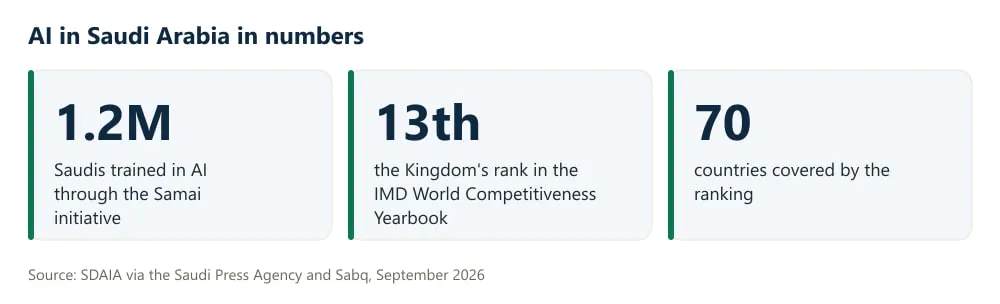
In September 2026, the Saudi Data and AI Authority (SDAIA) announced that Saudi Arabia ranked 13th out of 70 countries in the IMD World Competitiveness Yearbook, and third among G20 economies. The Kingdom also ranked 4th globally for public access to AI and 4th for AI adoption by companies.
SDAIA linked the access ranking to capacity-building efforts, including the "One Million Saudis in AI — Samai" initiative, which has helped train 1.2 million Saudis. Samai was launched by SDAIA with the Ministry of Education and the Ministry of Human Resources and Social Development. It is delivered online, in Arabic, and free of charge for citizens.
Why this matters at work
Taken together, the two figures tell a clear story: AI awareness is widespread, and companies are already putting it to use. Knowing the concepts no longer sets anyone apart. What does is the ability to turn a tool into something you can hand over: a clean report, a persuasive email, an accurate summary.
Three groups should pay particular attention:
- Office and administrative staff who write, summarise and correspond every day.
- People who deal with international counterparts in procurement, sales and customer service, where English correspondence is part of the job.
- Job seekers who have completed general AI training and want to show real, applied use in an interview.
From certificate to skill: five practical steps
- Pick three recurring tasks. Meeting summaries, reply drafts, a comparison table. Focus on those alone for two weeks.
- Write a prompt the way you would brief a colleague. State the role, goal, audience, length and tone. "Summarise" alone gets a generic result; "summarise in five bullet points for a finance manager who only wants the risks" gets a usable one.
- Check every number, name and date. AI tools write confidently even when they are wrong. The person who hits send is accountable.
- Protect data. Do not paste contracts, customer records or internal figures into a tool your employer has not approved. Ask your IT team what the policy is.
- Build a prompt library. Save the prompts that work and refine them. Within a month, you will save noticeable time every week.

Where English comes in
Many AI tools handle Arabic well, yet a large share of business correspondence with international suppliers and partners is still in English. That creates a common gap: the tool produces grammatically correct text, but the employee cannot judge its tone or precision. Is the sentence overly deferential? Could it read as a commitment the company never meant to make? Judging the output takes a foundation in the language, and the tool cannot supply that for you.
Common mistakes
- Pasting the output as is. Machine-written text needs review and adapting to your company's context.
- Stopping at the certificate. A certificate shows you learned; real examples from your own work show you apply it.
- Long, vague prompts. Clarity matters more than length.
- Ignoring data policy. One slip can cost the company more than the tool saves in a year.
How we can help
If you want to build both skills together, Future Skills Institute — licensed by the Technical and Vocational Training Corporation (TVTC) — offers Business English Essentials with AI. It is a 12-hour programme with an accredited training plan, focused on writing professional English correspondence and using AI tools to draft and review it. It complements what you learned in national initiatives rather than replacing it.
Sources
- Sabq: Saudi Arabia ranks 13th in competitiveness and trains 1.2 million Saudis in AI (Arabic)
- Ajel: Saudi Arabia strengthens its global lead in AI and international indicators 2026 (Arabic)
- SPA: SDAIA and the Ministries of Education and HR invite citizens to join the one-million AI training initiative (Arabic)