The question usually arrives late
An HR manager at a Riyadh contracting firm gets an email from the client a week before the project starts: attach the safety certificates for your site team. He opens the personnel files and finds attendance slips from an internal workshop, a foreign card for one person, and nothing for the rest. The question he asks himself that night is the one that reaches us every week: what actually obliges us, and what is enough?
We answer here from what the regulations say, then state plainly where our programmes stand — and we keep the two clearly apart.
First: what the Labour Law itself requires
Before any specialist regulation, the Saudi Labour Law places a direct training obligation on the employer, not merely a duty to notify.
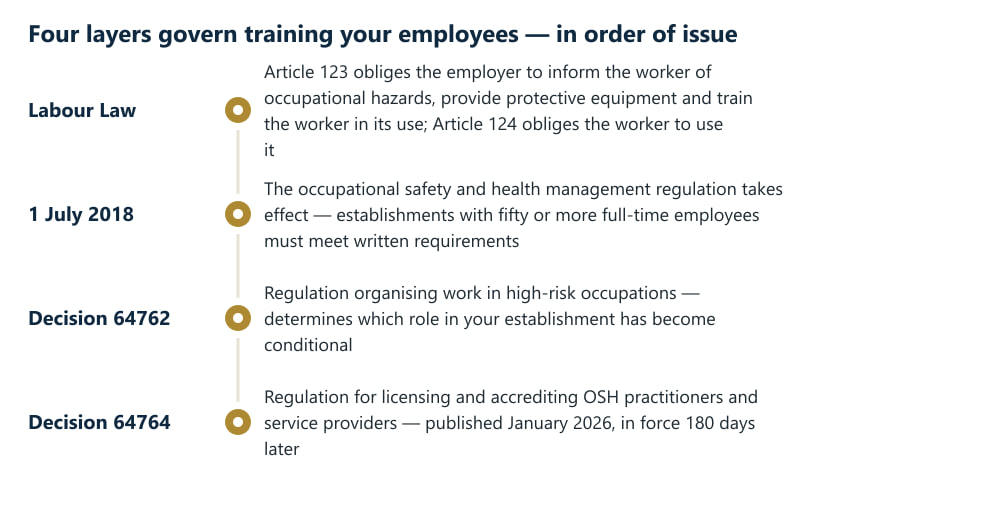
Article 123 obliges the employer to inform the worker, before starting work, of the hazards of the occupation, to require the use of the prescribed protective means, to provide personal protective equipment and to train the worker in its use. Article 124 is its counterpart, obliging the worker to use and maintain those means.
Read the difference carefully: the law does not say "provide a helmet"; it says provide it and train him on it. A file holding an equipment purchase receipt with no training record is half compliance.
Second: the occupational safety and health management regulation
The occupational safety and health management regulation took effect in the Kingdom on 1 July 2018, and it obliges establishments with fifty or more full-time employees to meet written requirements.
The word "written" matters most in practice: what is not documented does not read as compliance at review. An establishment that genuinely trains but keeps no training record and no verifiable certificates stands before the reviewer exactly where one that never trained stands.
And note the threshold: fifty full-time employees. Many companies cross it without noticing — a contractor growing from thirty to seventy during a single project enters the scope mid-year, not at its start.
Third: high-risk occupations
Then came the regulation organising work in high-risk occupations, approved by decision of the Minister of Human Resources and Social Development no. (64762) dated 13/5/1447H.
Its practical effect on an employer is direct: some roles can no longer be filled simply by someone who "knows the job", but by someone who meets a stated requirement. Reviewing your team's roles against this regulation is not organisational luxury — it is what tells you which of your positions has become conditional.
Fourth: licensing the safety practitioners themselves
The most recent in effect: the regulation for licensing and accrediting occupational safety and health practitioners and service providers, issued by decision no. (64764) dated 13/5/1447H, published in the official gazette in January 2026, and in force 180 days after publication.
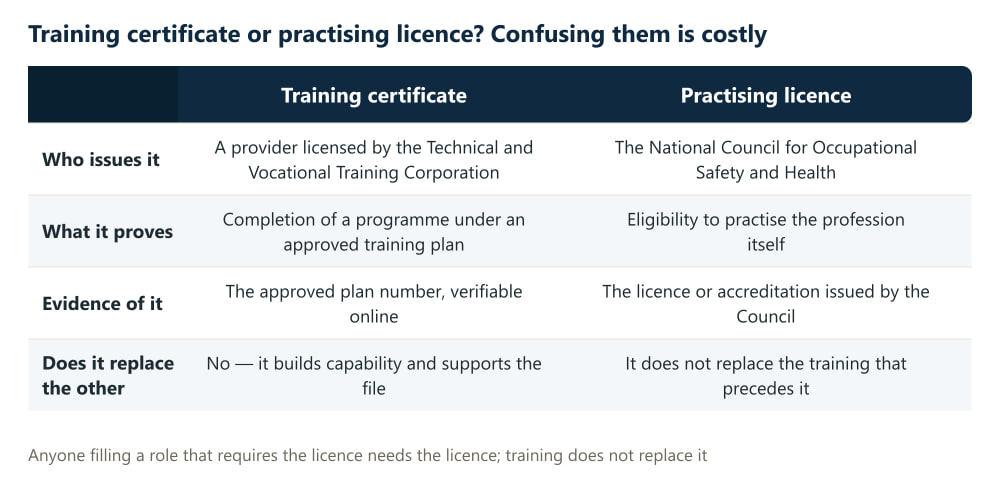
It states that none of the occupational safety and health professions may be practised, nor their services provided, without a licence or accreditation issued by the National Council for Occupational Safety and Health.
A common confusion deserves clarity here: a training certificate is one thing; a practising licence is another. Anyone filling a role that requires the licence needs the licence; training builds the capability and supports the file without replacing it. Any training provider who suggests otherwise puts you in the difficult position, not themselves.
What makes training "accredited" in front of a reviewer?
Two questions separate a useful certificate from a piece of paper:
The first: is the provider licensed?
Private training in Saudi Arabia is licensed by the Technical and Vocational Training Corporation. The scale of the system explains why verification became possible at all: licensed private training establishments reached 2,234 in 2024, and during 2022 the Corporation approved more than 1,250 training programmes for sector establishments.
The second: does the programme carry an approved plan number?
The licence belongs to the provider; the plan number belongs to the programme itself. A licensed provider may still deliver an unaccredited programme — and the difference shows on the certificate, not in the pitch deck.
Because this is the standard, we publish ours on the programme pages directly: Occupational Safety and Health — Introductory carries plan number 93823, and the Accredited Foundation programme carries plan number 94015.
Four questions to ask before you sign
Ask them of any training provider — us first:
- What is the approved plan number for this specific programme? Not for another one you run.
- How does our reviewer verify an employee's certificate a year from now? Show us the method, not the promise.
- Who issues the certificate? You, or a third party? And whom do we address if we disagree?
- What does this programme not cover? A provider who cannot answer this has not understood your position.
The fourth is the differentiator. A provider who tells you "this covers everything you need" is selling; one who says "this covers X and does not replace Y" is working with you.
Where we stand, honestly
Future Skills Training Company is licensed by the Technical and Vocational Training Corporation, and our accredited programmes carry plan numbers published on their pages.
And we say it as we say it to every client: our certificate is a training certificate issued by a licensed provider under an approved plan. It is not a practising licence, and not a substitute for an international qualification if your project names one. What it does give is a professional grounding in Arabic that hands your team the language and concepts of the field: risk assessment, incident investigation, personal protective equipment, and permits to work.
Your team — or your client — can verify any certificate we issue without coming back to us. That point is tested at the first review, not at signing.
Where to start in practice
- Count: how many full-time employees do you have? The threshold is fifty, and you may have crossed it this year.
- Classify the roles: which fall under high-risk occupations, and which require a practising licence.
- Review the files: for every employee in an exposed role, is there a verifiable certificate or an attendance slip?
- Ask for a proposal by role, not by headcount: twenty employees across three different roles do not need the same programme.
If you would rather we started at step three, request a proposal for your team and send us the role breakdown — we will send back what each role needs, and what it does not.