Head office says "we have a global standard". The inspector asks something else
A regional safety manager at a European engineering firm with a new Riyadh branch presents his team with a training matrix approved by head office: clear pathways, one global provider, a tidy digital record. Then a question arrives from a local adviser: and where is the approved plan number?
The question is not administrative friction. It is the difference between a file that reads here and a file that needs explaining every time.
First rule: the law follows the place of work, not the place of headquarters
Your employee in Riyadh works under Saudi Labour Law whatever your head office is. Article 123 obliges the employer to inform the worker, before starting work, of the hazards of the occupation, and to provide personal protective equipment and train the worker in its use; Article 124 is its counterpart, obliging the worker to use and maintain those means.
Which means a training matrix approved at head office does not cancel the local obligation and is not exchanged for it. It is added to it.
What your international certificates do not replace
None of what follows diminishes international qualifications; they are real value in an employee's file. But each has a boundary:
The occupational safety and health management regulation took effect in the Kingdom on 1 July 2018, obliging establishments with fifty or more full-time employees to meet written requirements. A fast-growing branch usually crosses that threshold before its local policies are updated.
Then the regulation for licensing and accrediting occupational safety and health practitioners and service providers was issued by decision no. (64764) dated 13/5/1447H, published in the official gazette in January 2026, and in force 180 days after publication. It states that occupational safety and health professions may not be practised, nor their services provided, without a licence or accreditation from the National Council for Occupational Safety and Health.
The line your legal team needs: an international qualification strengthens the file; the local licence opens the role. They do not swap places.
A third regulation addresses the roles themselves: the regulation organising work in high-risk occupations, decision no. (64762) dated 13/5/1447H — it is what determines which position in your branch has become conditional.
Language is not an operational detail
Most site teams in Saudi Arabia work in Arabic, and many are multinational. Safety training delivered in English to a team that thinks in Arabic produces documented attendance and incomplete understanding — and that is the dangerous part: the record looks sound and the knowledge is not there.
That gap shows up in the post-incident investigation, not in the pre-audit.
Local accreditation: what makes a certificate readable here
Private training in Saudi Arabia is licensed by the Technical and Vocational Training Corporation. Licensed private training establishments reached 2,234 in 2024, and during 2022 the Corporation approved more than 1,250 training programmes.
The document a local reviewer understands immediately is a certificate from a licensed provider under an approved training plan carrying a published number. That is why we publish ours on the programme pages: Introductory under plan 93823, and the Accredited Foundation programme under plan 94015.
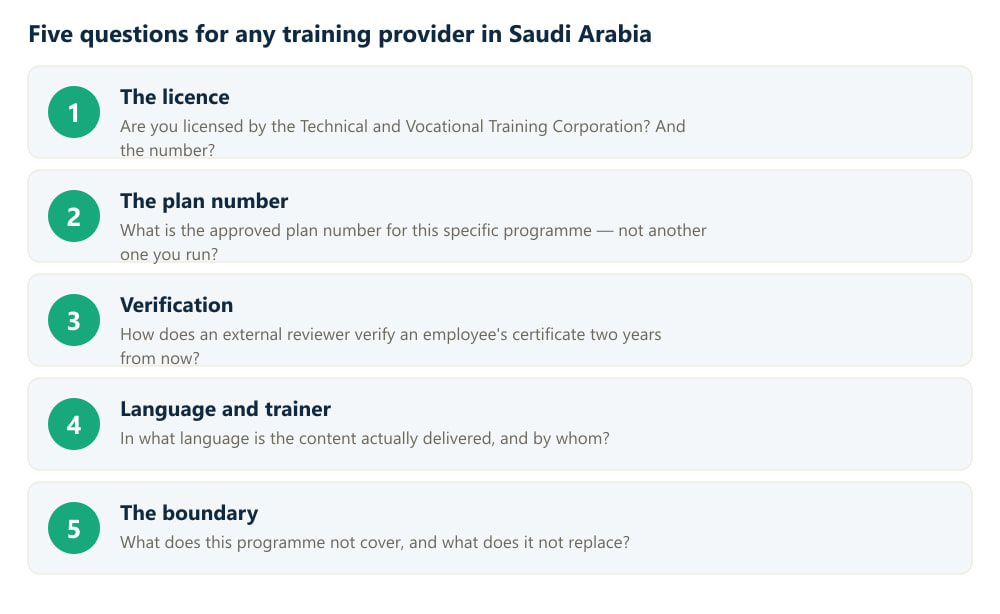
Five questions for any training provider in Saudi Arabia
This list works for any provider, and we invite you to start with us:
- Are you licensed by the Technical and Vocational Training Corporation? And the number?
- What is the approved plan number for this specific programme?
- How does an external reviewer verify an employee's certificate two years from now?
- In what language is the content actually delivered, and by whom?
- What does this programme not cover, and what does it not replace?
How we work with branches of foreign companies
We start from your matrix, not our catalogue: we take the role breakdown and the head-office policy, identify where what you already have is sufficient and where a locally accredited programme is required — then propose only the gap.
Delivery is at your site or online, in Arabic, under an approved plan. Your team — or your external auditor — can verify every certificate without coming back to us.
And we say it plainly, as we do to every client: ours is a training certificate from a licensed provider under an approved plan. It is not a practising licence, and not a substitute for an international qualification if your contract names one.
Start here
Send us the role breakdown for the branch and the training matrix approved by head office, and we will return a table with three columns: what is sufficient as it stands, what needs a locally accredited equivalent, and what is not ours at all — with a pointer to whose it is.
Request a proposal for your team or write to us from the contact page.