
What does "accredited" actually mean?
An engineer joins a project in Riyadh and is told, before he can set foot on site, to bring an accredited safety certificate. That evening he searches, and finds dozens of adverts carrying the same word at prices that differ several times over. Which of them is actually accredited? The advert never says.
The word itself is the problem. In the training market "accredited" carries three separate meanings, and buyers read them as one. The first is establishment licensing: the training provider itself holds a government licence to operate as a training provider at all. The second is programme approval — the specific course, its content, hours and objectives, was submitted to the authority and approved, and now carries a registered approval number. The third is professional practice licensing, which attaches to a person rather than to a course: a licence to practise the occupational safety and health profession itself.
The certificate you buy from a course relates to the first two. The third is an entirely separate track, and it gets its own section at the end of this guide, because confusing it with the others does trainees the most damage.
The role of the Technical and Vocational Training Corporation
The Technical and Vocational Training Corporation (TVTC) is the body that licenses private training establishments in Saudi Arabia and approves their programmes. According to the executive rules and procedures of the Private Training Regulation published in the Umm Al-Qura gazette, a licence is the Corporation's approval to invest in training, it runs for five years, and the Corporation may approve a training programme, return it for amendment, or reject it.
Those rules classify programmes by duration and hours. A "developmental course" is a programme lasting no more than one month with no more than sixty training hours, while a "qualifying course" runs longer than a month and less than a year with more than sixty hours. Short safety programmes — one day or three days — fall into the developmental course category, which is precisely the category for which the rules require the approval number to be stated.
The scale of the system is what makes verification possible in the first place: there were 2,234 licensed private training establishments in 2024, and during 2022 the Corporation approved more than 1,250 training programmes for private-sector establishments, after review by specialist arbitrators and a check that the content meets the standards. A register that wide means one question is enough to tell the registered from the merely claimed.
The training plan number: the question that settles it
The plan number — or approval number — is the course's identifier in the Corporation's records. Publishing it is a regulatory obligation before it is a courtesy on the provider's part. Rule Twenty-Six of the executive rules requires establishments to advertise activated training programmes together with the approval number for developmental courses.
Its value to you is that it moves the promise out of the seller's mouth and into a third party's records. When you ask for the number before paying, you are asking one thing only: is this specific course registered and activated, or has an attractive title been placed on unapproved content? If a course has no approval number, ask in writing what the provider means by "accredited": which body granted it, under what number, and whether it is currently valid.
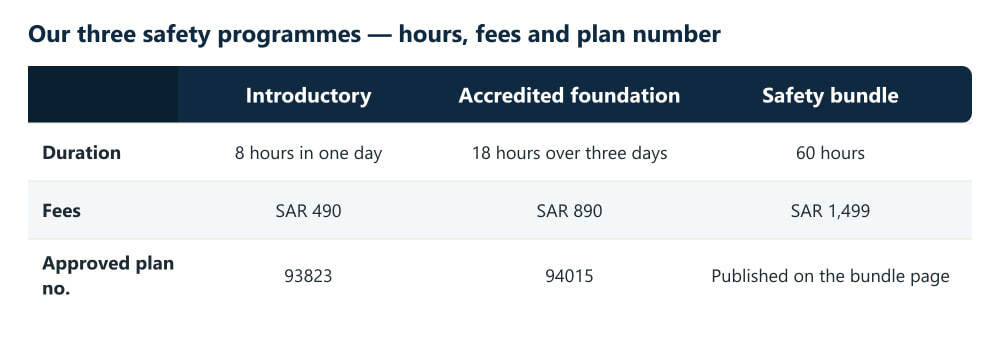
Because this is the standard, we publish ours directly on the programme pages: Occupational Safety and Health Essentials carries plan number 93823, and Certified Occupational Safety and Health Foundation carries plan number 94015. Both numbers are printed on the pages; you do not have to email us for them.
Attendance certificate versus accredited certificate
An attendance certificate proves one fact: that you sat in the room. Anyone can print one, because it rests on no external reference. An accredited certificate traces back to a programme registered with the Corporation, issued by a licensed establishment, and produced in line with the applicable training instructions.
Telling them apart takes no prior expertise. Look first for an approval number stated openly on the course; a logo or a brand name does not stand in for one. Then match the establishment name printed on the certificate against its licensed legal name, since what you recognise may be only a marketing identity. Then ask how whoever reads the certificate will check it after issue — is there a published channel, or does it come down to phoning a salesperson? That leaves the training hours, which should appear clearly on the certificate and match what was advertised before you enrolled.
How to check any training provider — including us
Make these steps a habit before you pay anyone, and apply them to us exactly as you would to anyone else:
- Look the establishment up in the Corporation's records. TVTC offers an electronic enquiry service covering licensed private training establishments and their approved programmes on its official domain tadreeb.tvtc.gov.sa, with a comparable service at pt-web.tvtc.gov.sa.
- Ask for the course approval number in writing before paying, and confirm it belongs to the course you will actually attend rather than to a different course at the same provider.
- Match the legal name. The name that will appear on your certificate is the licensed name, so make sure you recognise it before you enrol. We apply that to ourselves: our trading name is Future Skills Training Co, while the name recorded on our licence from the Technical and Vocational Training Corporation — and the name that will appear on your certificate — is Ma'had Maharat Al-Mustaqbal Lil-Tadreeb (Future Skills Training Institute). Ask us for the name exactly as it stands on the licence if you want to match it word for word before enrolling.
- Ask about the trainer. The Corporation issues a certified trainer licence under published criteria covering qualifications, experience, and passing professional competency tests or interviews.
Then comes a fifth question, and to our mind the decisive one: how will an employer verify your certificate later on? If there is no published answer, the certificate is only paper. We maintain a public certificate verification page that any employer can use to check a certificate we issued, without going through us at all. That is the test we are asking you to apply to everyone, ourselves first.
A course certificate is not a practice licence
This is where the costliest confusion sits. The Regulation for Licensing and Accrediting Occupational Safety and Health Practitioners and Service Providers was issued by decision number (64764) dated 13/5/1447H of the Minister of Human Resources and Social Development, chairman of the National Council for Occupational Safety and Health. It was published in issue (5138) of the Umm Al-Qura gazette on 9 January 2026, and Article Thirty-Eight provides that it took effect one hundred and eighty days after publication — meaning it has been in force since July 2026. Its Article Eleven states that none of the occupational safety and health professions may be practised, nor their services provided, without a licence or accreditation issued by the Council. It sets two tracks for individuals — a professional track and a practitioner track — each with its own qualification and experience requirements.
So hold on to this distinction.
Any safety course, ours or anyone else's, gives you a training certificate evidencing knowledge you acquired, and it does not give you a practice licence for the safety profession. Anyone promising otherwise is selling you an illusion. A training certificate is a building block in your professional file, not a substitute for the licensing route.
Why the labour market asks for this training
The demand is an obligation under the Labour Law before it is an administrative preference. Article 123 requires the employer to inform the worker, before starting work, of the hazards of the occupation, to require the use of the prescribed protective measures, and to provide personal protective equipment and train the worker in its use. Article 124 places the matching duty on the worker to use and maintain those measures. The text spreads the responsibility across both sides.
The direction has been reinforced by the establishment of the National Council for Occupational Safety and Health, which governs the field nationally and offers awareness and training programmes at three levels — basic, advanced and professional — alongside the Ministry of Human Resources and Social Development's decision to Saudise the occupational safety and health profession. Documented safety competence has become both a regulatory and an employment requirement.
Which one to choose: essentials, foundation, or the bundle?
Occupational Safety and Health Essentials, 8 hours over one day, SAR 490, plan number 93823. Choose it if you are a new employee needing a quick grounding in hazard and prevention concepts, or a supervisor who wants shared language with the team. Or if you are testing the field before committing to a longer path. One day gives you the framework without the depth.
Certified Occupational Safety and Health Foundation, 18 hours over three days, SAR 890, plan number 94015. To our mind this is the default choice for anyone who wants a certificate that genuinely adds to their professional file, since three days is enough to move from definitions to application: risk assessment, protective equipment, safe work procedures, and documentation.
The Occupational Safety Bundle, 60 hours, SAR 1,499. It combines three strands: occupational safety, fire fighting, and construction safety. Choose it if you are building a path in safety rather than attending a single course, or if you work in a construction or industrial environment where hazards are varied. We would not recommend it to someone who wants one quick certificate; start with the essentials course instead. And note that the bundle is three strands bought together, and we do not publish one plan number for it as we do for the two safety courses above. So ask us for the approval details of each component before you pay, exactly as you would ask any other provider — the rule we are urging on you applies to us first.
From enrolment to certificate
- Pick the right level from the programme catalogue.
- Verify the establishment's licence and the course approval number before paying.
- Choose your attendance mode: in person at our Riyadh premises, or remotely by live broadcast.
- Complete payment — prices include VAT, and instalments are available through Tabby and Tamara — then attend the scheduled hours and meet the programme requirements.
- Receive your certificate, then verify it yourself before sending it to an employer.
Where to start
If you want a fast grounding, begin with Occupational Safety and Health Essentials. If you want a foundation certificate with more depth, Certified Occupational Safety and Health Foundation is the better fit, and if you are building a full path, the Occupational Safety Bundle shortens the road. To train a whole team inside your organisation, see corporate training, and for any question before enrolling you will find us on the contact page.