

It is 8 a.m. in Riyadh. Sara, a project coordinator, has twelve tasks on her list, forty emails in her inbox and a meeting at ten. By 2 p.m. she has answered every email, yet the report her manager is waiting for has not been started. That gap is why so many people search for a time management course: not because they are lazy, but because their day is run by whatever arrives rather than by what they choose.
What a time management course actually teaches
Time management is not a colourful planner or a new app. It is a handful of small decisions repeated every day:
- Prioritising: telling the important from the urgent. Not everything that shouts matters.
- Realistic planning: estimating tasks honestly and leaving a buffer for surprises.
- Protecting focus time: blocking interruption-free periods for work that needs thinking.
- Saying no politely: declining or deferring a request without damaging the relationship.
- Reviewing: a few minutes at the end of the day asking where the time went.
The last one is the step most people skip. If you do not know where your time leaks, you cannot win it back.
Who benefits most
Anyone who works gains something, but three groups see the clearest difference:
- New employees moving from study into overlapping tasks and deadlines.
- Supervisors and team leads whose time is now split between their own work and their team's questions.
- Public-facing staff in reception, customer service and sales, whose day is broken up by every call and visit.
For that third group, time management and communication are the same skill. Knowing how to close a call courteously and set a clear reply time saves a real share of the day.
Is there a free time management course?
Yes. Doroob, the e-learning platform of the Human Resources Development Fund (HRDF), offers a free online course called "Effective Time Management". It takes an estimated three hours, and a completion certificate is issued once you reach 70% of the requirements. It is a sound starting point if you want the core concepts at your own pace.
The difference with a live course is practice. In a classroom you analyse your real day with a trainer, get feedback on your plan and rehearse situations such as declining a meeting or delegating a task. Choose based on what you need: knowledge alone, or knowledge plus practice.
Practical steps to start today
You do not need to wait for a course. Try this for five working days:
- Log your time for two days exactly as it is. Note what you did every half hour.
- Pick only three tasks each morning and call the day a success if they are done.
- Book one focus hour at your most alert time and switch off notifications.
- Batch small tasks such as emails and calls into two fixed windows.
- Review for five minutes before leaving and set tomorrow's three tasks.

Common mistakes
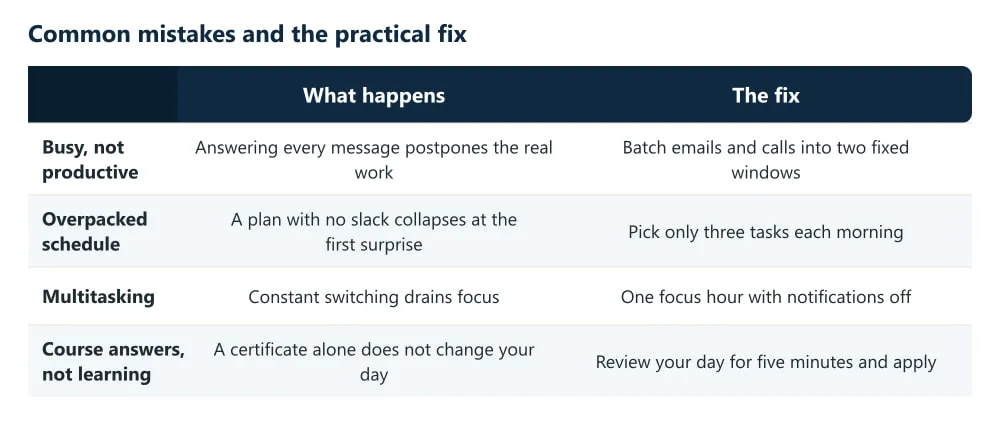
- Confusing busy with productive: answering every message instantly feels like output but often postpones the real work.
- Overpacked schedules: a plan with no slack collapses at the first surprise, and you abandon it.
- Multitasking: constant switching drains focus and makes every task take longer.
- Hunting for course answers instead of learning: a certificate alone will not change your day; applying the method will.
The related programme at FSI
If you want short, hands-on training that combines both skills, the Time Management and Public Communication programme at Future Skills Institute runs for three hours and has a TVTC-approved training plan. It covers prioritising and structuring your day, and handling visitors and customers without letting them consume your time. The institute is licensed by the Technical and Vocational Training Corporation (TVTC).