The question reaches us in almost identical words every time: how much does a PMP certification cost? The answer is three amounts rather than one, paid to two parties, in two currencies. You pay a training provider in Saudi riyals for at least 35 hours of formal training; you pay the Project Management Institute (PMI) an exam fee in US dollars; and then you decide whether to take out an optional PMI membership, which lowers the exam fee and the later renewal fee alike. Above all of that sits a requirement money cannot buy: real years of leading projects.
So we start with the requirements, because spending before you meet them is spending in the wrong place.
PMI's eligibility rules: four routes in
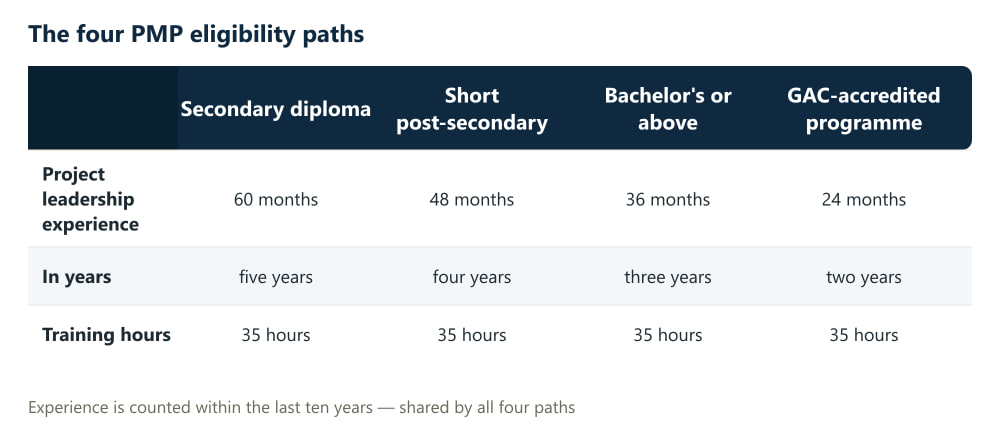
PMI updated its eligibility criteria with the exam edition released in July 2026. Applicants now enter through one of four routes, depending on their academic qualification:
- Upper-secondary school completion or equivalent: 60 months — five years — of experience leading projects.
- A short post-secondary qualification, such as an associate degree or an advanced technical or vocational diploma: 48 months, or four years.
- A bachelor's degree or higher: 36 months, or three years.
- A bachelor's or postgraduate degree from a programme accredited by PMI's Global Accreditation Center (GAC): 24 months, or two years.
All four routes share one further item on top of the experience: 35 hours of project management training. The single exemption goes to an active CAPM holder, for whom the 35 hours are credited automatically.
And there is a time limit that drops out of most people's calculations: the experience must fall within the last ten years. The window was eight years before the 2026 update, so anyone leaning on an older engagement has more room than they think.
How the experience is actually counted
A project engineer at a Riyadh contracting firm led three projects across six months, then recorded eighteen months on his application. It is a common mistake, and a fatal one. Six months stay six however many projects ran inside them, overlapping periods count once, and the unit of counting is the month, not the project.
Even so, every project is listed separately on the application, however many there are. The experience also has to be professional by nature: school projects, academic research for a degree, planning private events and home improvement work do not count, and routine, operational and administrative tasks are excluded as well. What is being asked for is leading and directing, not sitting on a team. The work does not have to be paid, but it does have to sit in a professional setting.
The audit, meanwhile, is a random selection PMI runs across a sample of applications. You would then be asked for a copy of your qualification, a signature from your manager for each recorded engagement, and certificates from your training providers. You have ninety days to submit them, and the review then takes five to seven business days. The heavier cost, in our view, is that your eligibility period only starts the day you clear the audit — an application filled in hastily with loose figures costs you weeks of your working life before it costs you a riyal.
The 35 formal training hours: what does PMI accept?
PMI accepts these hours from several sources: its Authorized Training Partners (ATP), GAC-accredited programmes, project management courses at accredited higher education institutions, employer-run programmes, training companies and institutes, and self-paced recorded courses that end with an assessment. It states plainly that books and practice exams alone are not accepted, that all training is subject to audit, and that it reserves the right to reject training it judges to be of poor quality.
The arithmetic is simple. One hour of classroom instruction equals one hour, and a university course meeting three hours a week for fifteen weeks equals 45 hours. If only part of a course covered project management, only that part's hours count.
This is where our Project Management Professional PMP programme sits: 35 training hours across seven days, covering the hour requirement in full and preparing you for the exam content, at SAR 2,800 including VAT, in person in Riyadh or remotely by live broadcast. If you specifically want an ATP-listed provider, check PMI's authorized partner directory before enrolling.
The PMI exam fee: why we will not give you a figure
PMI does not publish a single fixed figure for the PMP exam fee on its public site.
Its official certification handbook, June 2026 revision, states that certification fees are subject to all applicable charges and that prices may vary according to the candidate's membership status and regional location. The figure appears to you in US dollars inside your my.pmi.org account after your application is accepted, not before — PMI's own site says the exam fee is only required once your application has been accepted and you are ready to schedule. We will not quote an estimate here either. Unofficial sites circulate conflicting numbers, the fee has been revised more than once, and publishing a stale figure is worse than publishing none. Check pmi.org or your my.pmi.org account for the live number, and remember that the fee is subject to change and that applicable taxes may be added at checkout.
What can be stated firmly from PMI's official sources is that membership lowers the exam fee: PMI's membership page advertises up to 30% off certifications and renewals. The handbook attaches a decisive condition, though — the member rate applies only to candidates who obtained membership before paying the certification fee. The order of your steps alone saves money, and we would never advise paying the exam fee before you have settled the membership question.
Four scheduling and payment rules sit alongside it:
- You get three attempts within one year of application approval, and the second and third attempts require paying the fee again.
- Rescheduling or cancelling within 30 days of your appointment costs US$70 plus taxes.
- Within 48 hours of the appointment there is no rescheduling and no cancelling, and a no-show forfeits the entire exam fee.
- A refund may be requested within 30 days of purchase, provided you have not scheduled and sat the exam in that window.
PMI membership: the third item, and it is optional
Membership is not required to earn the certification. It does lower the exam fee and the renewal fee that follows, and its own price is likewise absent from any public page: the figure appears only inside the shopping cart once you sign in to your account. PMI states that it offers no discounts on membership dues, and that new members are charged a small processing fee which is not repeated at renewal.
What follows is a subtraction: if the gap between the member and non-member price exceeds the membership fee, joining is cheaper — provided you join first. Check both numbers in your account before deciding.
The exam itself
180 questions, of which 170 are scored and ten are pretest questions that do not affect your result, in 240 minutes — four hours, with two ten-minute breaks. The content splits into People 33%, Process 41% and Business Environment 26%. It is taken at a test centre or remotely under online proctoring, and it is available in Arabic among other languages.
Certification validity and renewal through PDUs
A PMP certification is valid for three years, and the renewal cycle starts the day you pass the exam. Renewal requires 60 professional development units (PDUs) within that cycle, distributed as follows:
- At least 35 Education PDUs, including a minimum of eight in each of Ways of Working, Power Skills and Business Acumen, with the remaining eleven in any of those areas.
- A maximum of 25 PDUs in the Giving Back category: volunteering, creating knowledge, and working as a professional up to a maximum of eight units.
One PDU equals one hour, and partial hours count in quarters: 45 minutes is 0.75, 30 minutes is 0.5.
Four constraints along the way are easy to forget. Activities completed before you earned the certification do not count. Up to 20 PDUs may carry over to the next cycle, provided they were earned in the final twelve months of the current one. The renewal fee is entirely separate from PMI membership dues, is likewise subject to membership and regional pricing, and appears in my.pmi.org. And failing to meet the requirements suspends the certification for a full year; if it is not renewed within that year the certification expires, and you must reapply and sit the exam again.
Where to start in practice
The sounder move is to start with the arithmetic, not the application:
- Add up your months of leading projects over the last ten years, without overlap, and match them against your academic route.
- Complete the 35 training hours — which is what the PMP programme at Future Skills Training Co delivers in seven days.
- Submit your application on pmi.org, and prepare for a possible audit by keeping your certificates and managers' details on hand.
- Decide on membership before paying the exam fee.
- Schedule the exam within your eligibility year, and start tracking renewal units from day one.
If you want to weigh this route against others, the programme catalogue and the skills assessment are good starting points. For the next cohort date or instalment options through Tabby and Tamara, reach us through the contact page or on WhatsApp at +966 53 987 4076.