Three names in one job advert
A site supervisor in Riyadh pays out of his own pocket for an OSHA 30 card, carries it into an interview with a tier-one contractor, and the safety manager asks about his professional qualification instead. The situation is a common one, and it starts with a mix-up between three names that keep appearing in Saudi safety job adverts: OSHA 30, NEBOSH and IOSH. They look interchangeable. They are three different kinds of thing — an American government awareness programme, a British examined qualification, and a training programme quality-assured by a British professional body.
Below is what each one is, described the way its own issuing body describes it, followed by the question that really matters: where each is asked for in the Saudi market, and how local accreditation fits into the picture.
OSHA 30: an American awareness programme, not a licence
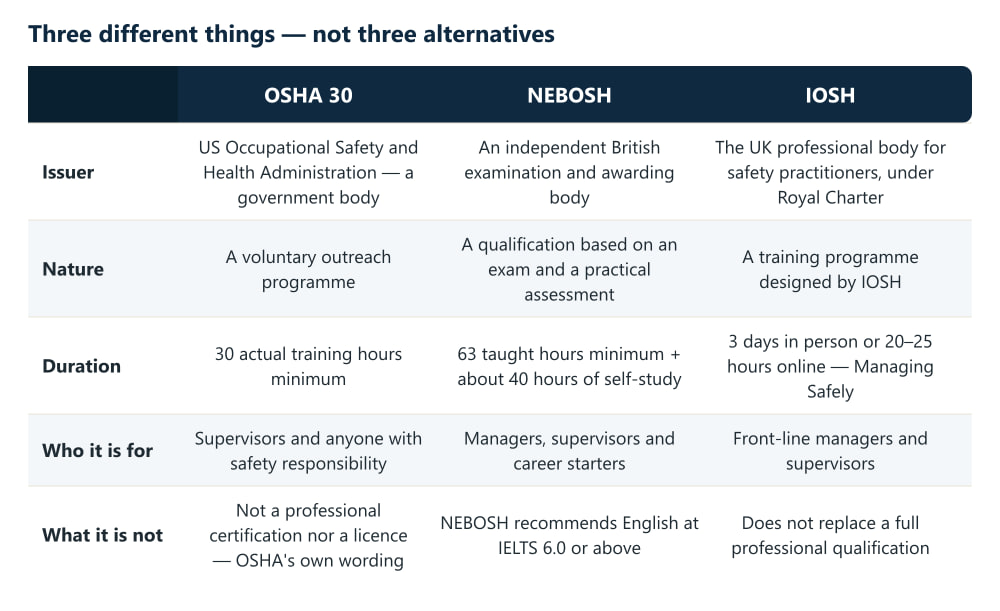
OSHA stands for the Occupational Safety and Health Administration, a US government agency under the Department of Labor. The Outreach Training Program, which contains both the 10-hour and 30-hour courses, is voluntary, and OSHA states plainly that it does not require Outreach training.
An OSHA-authorized trainer issues the card, and it is processed through the authorizing training organization — an OSHA Training Institute Education Center. It runs a minimum of 30 actual training hours and cannot be compressed into a single day, whatever a marketer promises you. The streams available are construction and general industry, along with maritime and disaster site work. OSHA explains that the 10-hour course gives workers basic awareness of common hazards and how to avoid them, while the 30-hour course is more appropriate for supervisors and workers with some safety responsibility.
Then the part that many card-holders never learned: OSHA states explicitly that the card is not considered a certification or a licence. It is evidence of completing an awareness programme. Nothing more.
NEBOSH: an examined qualification, and the exam decides
NEBOSH is an independent UK examining board and awarding body. It does not teach; it writes the syllabus and sets the assessment, while accredited learning partners deliver the training. That is why NEBOSH is described as a qualification rather than a course, and the distinction has a practical edge: whoever awards your certificate is not whoever trained you.
Its qualifications sit on levels: an entry-level Award, then an intermediate Certificate, then a Diploma for the professional practitioner at Level 6, and then master's degrees delivered in partnership with the University of Hull. The best known in our market is the International General Certificate:
- Units: two. An open-book, scenario-based examination followed by a closing interview, and a practical assessment in which the learner produces a risk assessment and action plan for a real workplace, over 3 hours.
- Approved duration: a minimum of 63 taught hours, plus roughly 40 hours of private study and background reading. Some centres run it intensively over 10 working days.
- Entry requirements: no prior qualification is required, but NEBOSH recommends a standard of English equivalent to IELTS 6.0 or above, since the syllabus and assessment are in English.
- Who it suits: managers, supervisors and anyone with health and safety management responsibilities, as well as those beginning a career in the field.
The language requirement is where a good number of applicants here come unstuck. Anyone who reads technical English slowly pays for this qualification twice: once in fees, once in a resit. We would not advise enrolling before you measure your own level honestly.
IOSH: a professional body and short programmes
IOSH is the Chartered body for occupational safety and health professionals in the United Kingdom. Its training programmes are designed and quality-assured by IOSH itself and delivered through its network of approved providers.
The shortest is Working Safely: a one-day programme for anyone in any working role who wants the basics of safety and health. The better known is Managing Safely, aimed at line managers and supervisors, practical and skills-focused in character. IOSH does not publish a single fixed duration for it on its page; approved providers typically run it over 3 days in the classroom, or as roughly 20 to 25 hours of online study. IOSH certificates can be verified online through its own site, which employers value when they are reviewing a candidate they do not know.
The differences, briefly
OSHA 30 is American, awareness-based and carries no qualifying examination; its card is neither a certification nor a licence. NEBOSH is British, examined and practically assessed, and the heaviest of the three in hours and in the level of English it demands. IOSH is a short British programme aimed at supervisors and managers, and it does not replace a full professional qualification.
Where each is actually asked for in Saudi Arabia
Separating what the regulations require from what employers prefer is the whole story here. Blurring the two produces most of the mistakes.
What the regulations require
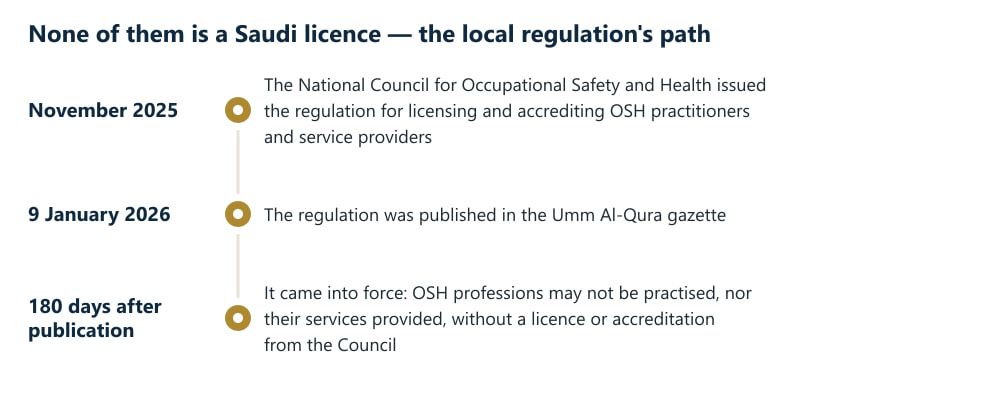
In November 2025 the National Council for Occupational Safety and Health launched the Regulation on Licensing and Accrediting Occupational Safety and Health Practitioners and Service Providers. It was published in the Umm al-Qura gazette on 9 January 2026 and came into force one hundred and eighty days later. It states that no one may practise any occupational safety and health profession, or provide such services, without a licence or accreditation issued by the Council. The regulation sorts practitioners into two tracks: a professional track covering senior consultant, consultant, senior expert, expert, senior specialist and trainer; and a practitioner track covering specialist, expert technician and technician, with level tied to academic qualification and experience.
The practical conclusion: neither OSHA nor NEBOSH nor IOSH is a Saudi licence. They strengthen your file with an employer and support your application, but they do not substitute for local licensing where your role requires it.
What employers prefer
In contracting, demand leans toward evidence that you understand site hazards: excavations, work at height, scaffolding, confined spaces and the permit-to-work system. In manufacturing and industry, machinery hazards, energy isolation, chemicals and fire safety move to the front. In oil, gas and tier-one contracting the bar rises, and the operator sets out its requirements in the tender documents and in its own contractor safety manual.
One piece of advice settles a long argument: do not rely on hearsay. Ask the organisation you are targeting for its requirements document in writing. What one operator requires, another may not, and requirements shift between projects, and between main contractors and subcontractors.
Where our programmes stand, honestly
Future Skills Training Co is licensed by the Technical and Vocational Training Corporation (TVTC). Our accredited foundational occupational safety and health programme carries approved training plan number 94015, and the introductory eight-hour occupational safety and health programme carries plan number 93823.
We say this plainly, because confusion here creates a genuine problem at hiring: our certificate is not an OSHA card, is not a NEBOSH qualification, and is not an IOSH certificate. It is a training certificate from a licensed provider, issued under a locally approved training plan carrying the number published above, and it should be read exactly that way. Any training provider that lets you believe otherwise is setting you up for an awkward moment in front of an employer. An employer can always verify any certificate we issue.
What these programmes genuinely give you is a professional foundation in Arabic, fast and low in cost, that hands you the vocabulary and concepts of the field: risk assessment, incident investigation, personal protective equipment and permits to work. Our own view is that someone starting from zero loses by committing straight to a long international qualification in English before finding out what the role they want actually asks for.
How to choose, in four steps
- Define the role precisely: a worker who needs awareness, a site supervisor, or a full-time safety officer.
- Get the target organisation's requirements in writing before paying for any programme.
- If you are starting out, begin with an accredited local foundation, then build on it what your particular market asks for.
- If your role requires licensing, read the National Council's regulation and its levels before anything else.
Where to start with us
If you are building the foundation, the accredited foundational occupational safety and health programme is the starting point: SAR 890 including VAT, 18 hours across 3 days, in person in Riyadh or remotely by live stream.
If you want wider coverage that adds firefighting and construction safety alongside occupational safety, the occupational safety bundle brings all three together across 60 hours for SAR 1499 including VAT, with instalments available through Tabby and Tamara.
For organisations training whole teams, the corporate training page sets out our training fields and how to request a quotation, with formal contracting and VAT invoicing.
The FAQ answers questions on registration, payment, instalments, certificates and how remote training works. For the next dates of the occupational safety bundle or the accredited foundational safety programme, reach us through the contact page or on WhatsApp at +966 53 987 4076.